
Have tough questions about immigration and naturalization records? From early immigration to recording deaths at sea, our genealogy records experts have the answers!
Jump to:
- Q: I have found a few of my male ancestors in naturalization records, but not my female ancestors (or any other women). Were women not allowed to naturalize in the 1800s?
- Q: My widowed great-grandmother Rosalie (Heinz) Thoendel immigrated from Germany to the United States in March 1877 with her four sons… How do I find the ship and immigration papers? Being a female, was she required to be naturalized? I am at a dead end.
- Q: Based on family stories, census records and other sources, my great-great-grandmother died on a ship coming to America with her husband and seven children in 1880… I can’t find any family members on ship records coming to Baltimore, New York, New Orleans and many other ports… What would my next step be?
- Q: How did immigrants arriving by ship get to their final destinations?
- Q: What is an alien registration number? Will it help me find out when my ancestor immigrated?
- Q: When were passports first issued? Where are passport records located? And, before passports, were records kept of an individual’s travels to foreign ports? Where can these be located?
- Q: My grandparents came to the United States in the early 1900s but never became citizens. They died in 1921 and 1950. I have been wondering lately about alien registration. Wasn’t this required yearly? When was it started and are any records available?
- Q: Several branches of my family came to United States in the 1860s from Sweden and Germany and England—before Ellis Island. Were these people automatically made citizens or did they have to apply for naturalization? Where would one go to learn of this procedure?
- Q: My grandfather’s half-brother may have emigrated to the U.S. from Sweden. Up until 1889, I can follow him in the Swedish church books–after that, nothing. Now what?
Q: I have found a few of my male ancestors in naturalization records, but not my female ancestors (or any other women). Were women not allowed to naturalize in the 1800s?
A: According to immigration historian Marian L. Smith in a 1998 issue of Prologue Magazine, “Unfortunately, the only rule one can apply to all US naturalization records–certainly all those prior to September 1906–is that there was no rule.”
She continues: “In general, immigrant women have always had the right to become US citizens, but not every court honored that right. Since the mid-19th century, a succession of laws worked to keep certain women out of naturalization records, either by granting them derivative citizenship or barring their naturalization altogether.”


In short: Some women could naturalize in their own right, but many didn’t. Women couldn’t vote in federal elections until 1920, giving them little incentive to go through with the paperwork and expense.
That wasn’t always the case, however. As of 1855, any immigrant woman married to a US citizen (either by birth or by naturalization) was “deemed a citizen.” Prior to 1906, a woman may not even be mentioned in the record that granted her citizenship–her only proof would be her husband’s naturalization documents and their marriage certificate. That applied to the couple’s non-citizen children, too.
Between 1907 and 1922, “citizenship by marriage” worked both ways. Women who were US citizens (even by birth) would lose their citizenship if they married an unnaturalized immigrant. Some women did go to court to request naturalization, though, and some judges granted citizenship to women regardless of the husband’s nationality.
The Married Women’s Act (a.k.a. the Cable Act), passed in 1922, finally gave each woman nationality in her own right. The naturalization process for women was similar to that for men, with one exception: Those whose husbands already naturalized didn’t need to file the first document, a declaration of intention.
Answer provided by David A. Fryxell.
A version of this article was published in the May/June 2026 issue of Family Tree Magazine.
Q: My widowed great-grandmother Rosalie (Heinz) Thoendel immigrated from Germany to the United States in March 1877 with her four sons. In May 1877, she moved to Columbus, Neb. How do I find the ship and immigration papers? Being a female, was she required to be naturalized? I am at a dead end.
A: Twenty-five percent of immigrants did not get naturalized, or even apply for “first papers” (also called a a declaration of intention, the first step in the naturalization process). Females and children were automatically naturalized under their husband or father until 1922—learn more about women and naturalization in this article from the National Archives’ Prologue Magazine. But a widow may have applied for naturalization on her own. From 1824 to 1906, minors who had lived in the United States for five years and were at least 23 years old could apply for naturalization immediately without first filing a declaration of intention. If the family members applied for naturalization, they may have filed in a local, district, state or federal court. Look for naturalizations in the Platte County court (Columbus is the county seat) and check indexes on the free FamilySearch.org as well as subscription sites Ancestry.com and Fold3.com.
The passenger list should normally be in the book series Germans to America. Unfortunately, I do not find Rosalie and her sons listed.
New York was by far the major port of entry for US immigrants, but other ports are possible, such as New Orleans for someone going to Nebraska (up the Mississippi River). You’ll find a free index for New York arrivals from 1820 to 1892 and the years after at StatueOfLiberty.org. Also check the immigration records collection at Ancestry.com, which includes indexes and records for nearly every US port. It may be necessary to view microfilms of ships arriving in March 1877 in New York.
Hamburg and Bremen were the largest German ports of emigration, but the Bremen lists no longer exist. One source that might simplify your search is the Hamburg Direct index, containing the names of those passengers on vessels that sailed from Hamburg directly to an overseas port. Learn more about the Hamburg Direct index at Genealogy.net. A bonus to this index is that if your ancestor is on it, you also find the last place of residence in Europe listed. Ancestry.com has passenger departure records from Hamburg, and so does FamilySearch.
Answer provided by Ernest Thode
Last updated: May 2026
Q: Based on family stories, census records and other sources, my great-great-grandmother died on a ship coming to America with her husband and seven children in 1880. The origination point was Poland. Her husband and children finally settled in Chicago. I can’t find any family members on ship records coming to Baltimore, New York, New Orleans and many other ports. I’ve scrutinized each microfilm for the years 1878 to 1882. The first record of the family is in the Chicago census of 1910, which mentions 1880 as the immigration year. I’ve also searched for naturalization records and found none. What would my next step be?
A: Genealogy experts suggest finding all the US records you can before jumping to passenger lists. It sounds like the earliest US record you have for this family is the 1910 census. If they did immigrate in 1880, that’s 30 years of unrecorded time. You don’t say which family members are in that 1910 Chicago census, but children on a ship in 1880 likely wouldn’t be living with their father 30 years later, so verify that you’ve found the right family in the census.
Your family could’ve moved around to any number of places—including Canada—between 1880 and 1910. So start with the earliest known location in 1910 and keep looking in US records. Have you tried searching Chicago city directories and newspapers around that time? Have you searched for death records, wills and probates of every family member? Looked for WWI draft registration cards for any male family members alive in 1917 and 1918? These records will provide clues to help you find the right passenger list. Not every immigrant was naturalized, so citizenship records may not exist for your family. If the 1910 census indicates your family members were naturalized, be aware that pre-1906 naturalizations could’ve been filed in any courthouse, so you’ll want to find out where they resided when naturalized.
A few pointers for finding family in passenger lists:
- Your family stories and the records you’ve found may be wrong about the year of immigration, and scrolling microfilm for every port is like looking for a needle in a haystack. Your time may be better spent searching online databases of passenger lists, such as those on Ancestry.com (your library may offer the free Ancestry Library Edition version) and FamilySearch.org. These will let you look for arrivals at all ports and broaden your arrival year range.
- Many immigrants “Americanized” their names after arrival, so your ancestors may appear on passenger lists with different names than the ones you know. Your continued searching in US records may turn up this name. And searching online passenger databases will let you experiment with spellings and wildcards.
- To learn more about Polish immigrants and develop theories for when and where your family migrated, consult books and references such as Polish Immigrants: 1890 to 1920 by Rosemary Wallner and John Radzilowski (Blue Earth Books) and explore the website of the Polish Genealogical Society of Chicago.
- Your family may have immigrated to Canada and later crossed the border into the United States. Canada started keeping passenger lists in 1865. Ancestry.com has an index to these records; you’ll also find indexes for some years and ports on the Library and Archives Canada website. US border-crossing records for most areas start about 1895 and also are in Ancestry.com’s immigration collection. Keep in mind that people crossing into the United States where no official entry port existed won’t be listed.
Last updated: May 2026
Q: How did immigrants arriving by ship get to their final destinations?
A: How our ancestors went from hither to yon depended on the time period and the cost of available transportation. Some immigrants had little choice but to settle in the port city for a while to find work and save up cash before taking off for their final destinations. An ancestor who landed in New York City and ended up elsewhere could’ve used a combination of ways to get there, taking a carriage to a dock, boarding a boat that took him by river to another dock, then another carriage or even a train to his final destination.
Depending on their means and how far they wanted to go, our ancestors traveled by foot or in carts, wagons, carriages or coaches along early national roads and paths. See Early American Roads and Trails, archived on the Wayback Machine) for descriptions and maps.
One of the most practical modes of transportation, especially for immigrants who arrived after 1800, was to hop on a boat and mosey on down (or up) a waterway. This is why most early settlements were along coastal areas and rivers. The Mississippi River, for example, connected Northern and Southern towns along its path. Tributaries, such as the Illinois, Chippewa, Saint Croix, Des Moines and Rock rivers, allowed travelers to get further inland. Add to that the Missouri River, which joins the Mississippi at St. Louis, and the Ohio River, which joins at Cairo, Ill., and our ancestors could travel just about anywhere.
Those who arrived in the mid-1800s or later could travel by rail. By the 1860s, railroads had replaced canals and rivers as the primary means for moving people and cargo, and in 1869, the Union Pacific and Central Pacific united the transcontinental railroad at Promontory Point, Utah.
Answer provided by Sharon DeBartolo Carmack
A version of this article appeared in the January 2010 issue of Family Tree Magazine. Last updated: May 2026
Q: What is an alien registration number? Will it help me find out when my ancestor immigrated?
A: An alien registration number, or A-number, is found on an alien registration card. If your ancestor wasn’t naturalized, he or she may have obtained such a card as part of the Alien Registration Program. As of July 1, 1940, every alien resident over age 14 had to register at a post office. Those entering the United States had to register when they applied for admission.

Each person was fingerprinted and filled out a two-page form called the AR-2. It was attached to another form, the Alien Registration Receipt Card (AR-3), with a perforation. The forms were numbered serially with an alien registration number. The Immigration and Naturalization Service (INS; now US Citizenship and Immigration Services, or USCIS) processed the forms, then the AR-3 went back to the person. He had to carry the card at all times and notify INS of an address change within five days. Address reporting became an annual requirement in 1952, and ended in the 1980s.
Early registrations (July 1940 to April 1944) are on microfilm at USCIS offices in Washington, DC, but they’re not open to the general public. You must submit a written Freedom of Information Act request.
To order copies of AR-2 files visit the USCIS’ Genealogy Program website or mail a letter or Form G-1041A, which you can download on the website, to USCIS, Attn: Genealogy Program, P.O. Box 805925, Chicago, IL 60680-4188. Identify the immigrant’s name, date and place of birth, and Alien Registration number (if known).
But be prepared for a long wait—the search may take several months.
Your ancestor’s alien registration card may not be one of the documents family members were apt to save. If you can’t provide the alien registration number with your request, it may not be filled. But if you’re successful, the cards can offer details on immigration, employment, military service, court records, any arrests, club memberships and other activities.
Answer provided by Lisa A. Alzo
A version of this article appeared in the November 2007 issue of Family Tree Magazine. Last updated: May 2026
Q: When were passports first issued? Where are passport records located? And, before passports, were records kept of an individual’s travels to foreign ports? Where can these be located?
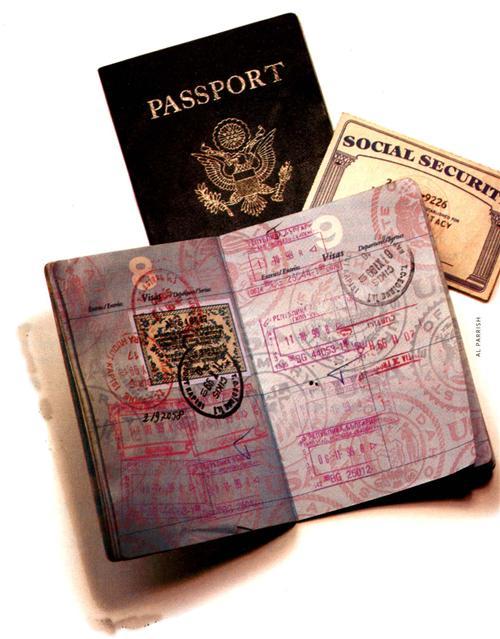
A: Except for brief periods during and after wartime — Aug. 19, 1861, to March 17, 1862, (Civil War) and May 22, 1918, to 1921 (World War I), passports were not required of US citizens who traveled out of the country prior to 1941. Many Americans, however, obtained them for their own security. Passports were, and still are, issued by the Department of State, and passport applications for those issued from 1791 to 1925 have been transferred to the National Archives. The originals are housed at the National Archives and Records Administration. Passport applications are on microfilm at this repository, and there are indexes and registers to help you use them. Both Ancestry.com and FamilySearch have collections of 1795 to 1925 passport applications available to search on their respective websites.
Early passport applications contain little information, but from 1906 to 1925 they included:
- Name of applicant
- Date and place of birth
- Name and date and place of birth of spouse or children
- Residence and occupation at the time of application
- Immediate travel plans
- Physical description
- A photograph
Passport applications of naturalized citizens included information about their immigration and naturalization, plus the date and port of arrival, name of ship, and the date and court of naturalization.
For passports after 1925, write or email the U.S. Department of State’s Office of Records Management. View their contact information and instructions on the State Department’s website. If the applicant of the passport is still alive, you will need a letter from the applicant; if the person is deceased, you need to provide a copy of the death certificate and state your relationship to the deceased.
Outbound passenger lists are filed with the foreign port of arrival. Check first the catalog of the FamilySearch under the country and port city to see if these records still exist. A better resource would be the passenger arrival lists to America when the individual returned from traveling to a foreign country.
Answer provided by Sharon DeBartolo Carmack
A version of this article appeared in the April 2001 issue of Family Tree Magazine. Last updated: May 2026
Q: My grandparents came to the United States in the early 1900s but never became citizens. They died in 1921 and 1950. I have been wondering lately about alien registration. Wasn’t this required yearly? When was it started and are any records available?
A: Aliens were required to register their current addresses and places of employment with the federal government between 1940 and about 1982. The Alien Registration Act of 1940 required aliens to report their address and employment, and to report any change of address immediately. Beginning in 1952, aliens had to report their address annually. Address reporting ended in the 1980s, and only the last or most recent address might remain on file.
You can request these records online from the US Citizenship and Immigration Service’s (USCIS) Genealogy Program. (The USCIS is the former Immigration and Naturalization Service.) Records for those born more than 100 years ago are available. You can order an index search, which is necessary if you don’t have the file number of the record you need. Then you can request the record for a fee that depends on the type of record you request. See the USCIS Genealogy Program website for more information and instructions on making your request.
Answer provided by Sharon DeBartolo Carmack
Last updated: May 2026
Q: Several branches of my family came to United States in the 1860s from Sweden and Germany and England—before Ellis Island. Were these people automatically made citizens or did they have to apply for naturalization? Where would one go to learn of this procedure?
A: Any immigrant coming to the United States in the mid-1800s would’ve had to be naturalized to become a citizen. Not everyone filed for naturalization, so keep this in mind when looking for records. For those who did file, the process was twofold: First, the newcomer would have filed a declaration of intent for citizenship (referred to as “first papers”). After fulfilling the residency requirement, he could then file his petition for naturalization. He had to sign these “final papers”—so if you can find that petition, you’ll have the added treat of seeing your ancestor’s John Hancock.
When male immigrants were naturalized, their minor children also automatically received citizenship. Between 1855 and 1922, their wives did, too. The federal government standardized the naturalization process (including the paperwork) in 1906. Since your ancestors arrived before that, they could’ve filed for citizenship in any court—they might even have started the process in one location, then completed it in another. To cover all your bases, you’ll need to hunt for records at the local, county and state levels.
Fortunately, naturalization indexes and record collections on websites such as FamilySearch.org, Ancestry.com and Fold3.com include some applications from before 1906. It’s easiest to start by searching online collections. If you find your ancestor in a naturalization records index, use the source information provided to track down the original record.
If you don’t find your ancestor online, your next step is to run a place search of the FamilySearch online catalog for locations where your ancestors might have petitioned, then look under the naturalization heading to identify records available on microfilm or viewable at a local FamilySearch Center.
If your online and FamilySearch catalog searches are fruitless, check archives at all three levels. The records may still be with the court where your ancestor filed, or they may have been sent to a state archives or other repository. Some archives and other official stewards of naturalization records have posted indexes and documents online. A Google search could turn these up, and NaturalizationRecords.com is also helpful.
If a naturalization took place in a federal court, all accompanying documents will usually be in the National Archives facility server the state in which the federal court is located. For more information, check NARA’s website.
Naturalization records can be a gateway to finding your ancestor’s passenger arrival list, as they often tell port and date of immigration (though the earlier the records, generally the less detail they contain). In fact, that’s how I confirmed the family story of my great-grandfather Henry Essel’s 1888 arrival through Philadelphia, enabling me to locate the ship manifest recording him and his family. You can learn more about the naturalization process in They Came in Ships by John Philip Colletta (Ancestry). Library and Archives Canada provides information on Canadian naturalizations.
Answer provided by Allison Dolan
Last updated: May 2026
Q: My grandfather’s half-brother may have emigrated to the U.S. from Sweden. Up until 1889, I can follow him in the Swedish church books–after that, nothing. Now what?
A: This is a good reminder to always examine your assumptions. We found your Edvard Svensson in Ancestry.com’s collection of Swedish emigrant church books. He left Sweden in October 1889, bound for Copenhagen (Denmark), not “Nordamerika.”
This detour might have complicated your search. It’s also possible he never went to the U.S. at all, as we can’t find a good match in later US census records.
To follow up, you could look for Edvard in the Danish Emigration Database to determine if he never left Denmark. You could also look in US passenger records, keeping in mind that he may have sailed from Denmark, not Sweden. If he stayed in Denmark long enough to be recorded in censuses there, you might find him in the Danish Demographic Database.
In a further possible twist, he might have returned to Sweden after a sojourn in Denmark. It could be worth checking Swedish parish household examination records after his 1889 departure to see if he pops up again. If so, it might even be possible to find a later emigration to the U.S.
Answer provided by David A. Fryxell
A version of this article was published in the May/June 2026 issue of Family Tree Magazine.
Related Reads